Case study
FoodTrack
Reducing waste and humanizing food bank management
Executive summary
Local food banks had no control over stock or expiration dates, which led to wasted donations, while standard baskets ignored recipients' real dietary restrictions. After 4 days of field immersion, I designed a stock management app with predictive expiration alerts and smart, personalized basket assembly, built with a minimal learning curve for volunteers. The result: basket assembly down from 4h to 2h30 (−38%); stock, waste and satisfaction measured for the first time; and recipients who described themselves as very satisfied, feeling more dignified, seen and welcomed.
Business context & the real problem
Working directly in local food bank operations, I identified a major operational and human challenge: well-meaning volunteer efforts held back by the lack of digital processes and proper tools.
Managing with informal notes or disconnected spreadsheets created two big problems
Logistics bottleneck and waste
Perishable food expiring on the shelves due to no inventory visibility and no first-in, first-out (FIFO) prioritization.
Lack of empathy in service
Generic food baskets handed out without considering household composition, allergies or health restrictions, leading to some donated items being thrown away.
Immersion & discovery (field research)
To investigate the operation's real pain points, I spent 4 days immersed in food banks, working alongside volunteers and interviewing recipients.
The 3 main research findings
Invisible stock
Volunteers didn't know exactly which items had to go out urgently, because there was no visual control of expiration dates.
Disconnect from the people served
There was no central record of the people served, so their history and specific needs couldn't be tracked.
Standard baskets vs. varied needs
Families received items they couldn't eat (e.g. homeless people receiving food that needed cooking, or Muslims and Jews receiving pork).
Discovery artifacts
Dual personas
The Volunteer (who needs an extremely simple, fast system) and the Recipient (who seeks dignity and a warm welcome).
User journey map
The whole cycle: from receiving the donation, sorting and storage, to delivery and recipient feedback.
Product decisions & trade-offs
Based on the discovery insights, the product definition prioritized these pillars:
Zero learning curve
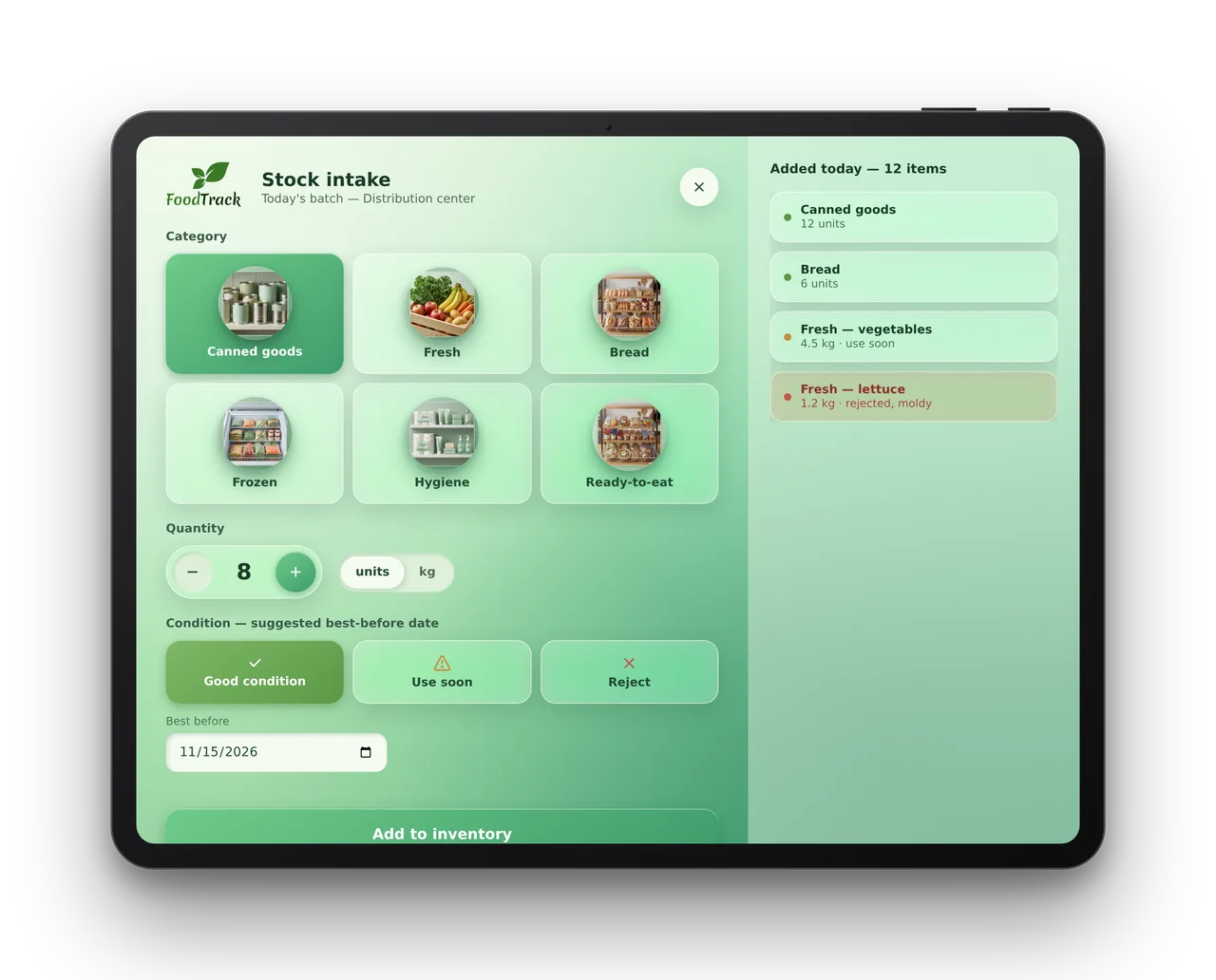
Since volunteers vary widely in age and tech familiarity, the interface was designed to be rich in visual cues (colors for expiration, simple icons and large buttons).
Predictive alert system
The software automatically puts the items closest to expiring at the top of the list, to be included right away in the next baskets.
Personalized basket assembly
A module that suggests basket contents based on the preferences/restrictions in the recipient's profile and the available stock.
Responsive architecture
Screens optimized for smartphones or tablets, used right in the food sorting area.
The solution (UI & workflows)
A. Stock dashboard & expiration alerts
A clear view of items in stock grouped by shelf life, so volunteers can quickly see what needs to go out first.
B. Human-centered recipient registration
A quick form to record the household profile, dietary restrictions, number of dependents and pickup history.
C. Smart basket assembly
A guided flow that suggests the right food for each family, combining the recipient's nutritional needs with the stock that needs to go out first.
Validation & business impact
- less time assembling baskets (from about 4h to 2h30)
- 38%
Operational efficiency
Less time spent by volunteers checking stock and organizing shelves.
Making the most of donations
Control over perishable items lost to expiration in the warehouse, now recorded for the first time.
Dignity in service
More of the delivered food is actually used, since baskets respect each family's dietary restrictions.
Before the system there were no metrics at all: no recipient records, no record of waste and no measure of satisfaction. With FoodTrack these indicators started being tracked, and recipients described themselves as very satisfied, feeling more dignified, seen and welcomed.
| Metric | Before | After | Change |
|---|---|---|---|
| Basket assembly time | About 4 hours | 2h30 | −38% |
| Recipient records | None | Centralized records with restrictions and history | New database |
| Food wasted due to expiration | Not recorded | Recorded and measured | New metric |
| Recipient satisfaction with baskets | Not measured | Very satisfied | New metric |
Learnings & next steps
Designing for the nonprofit sector and volunteer work reinforces that complex tools are quickly abandoned. The value of design here was turning industrial inventory logic into a smooth, empathetic experience.
Future improvements
Route mapping for collecting donations from large retailers, and push notifications to let recipients know about distribution days.